The NDPIA mosquito-borne pathogens and their vectors course was held during 7-10 of June 2022 at Umeå University. The course was conducted in a hybrid format, allowing some of the lecturers and students to participate online.
This course aimed at providing an in-depth understanding of pathogen-vector interaction and transmission dynamics of mosquito-borne pathogens, providing better understanding of mosquitoes as vectors of arboviruses and parasites most of which are zoonotic in nature and affect both humans and animals. We had twelve national and international experts covering various aspects of the mosquito vector including ecology, biology, population genetics, competence, capacity and how these factors influence transmission to the susceptible host. The course also covered vector surveillance, identification, diagnostics, prevention and control, as well as application of high-throughput sequencing platforms in virus discovery.
“I got the opportunity to learn a lot about the mosquito vector in both theory and the practical aspect by experienced researchers.”
-Anonymous participant
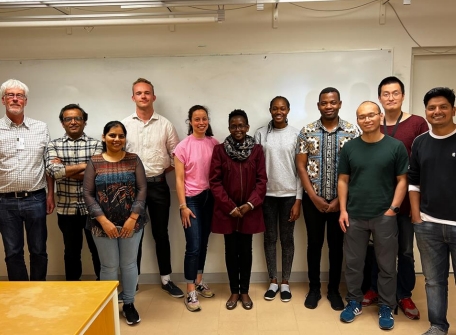
Group photo of some of the participants at the Mosquito-borne pathogens and their vectors course in 2022. Photo: Kristoffer Ahlm.
In addition to the lectures, this course included a field trip with mosquito trapping, a Swedish mosquito identification workshop, and a computational workshop on informatic workflow after barcoding and comparison of mosquito sequence data. Course participants were also given the opportunity to give a short presentation of themselves and their research activities, to further promote discussions and networking.
“The strength of this course was the high-quality presentations, well organized and efficient field work, communication and the flexibility for networking.”
-Anonymous participant
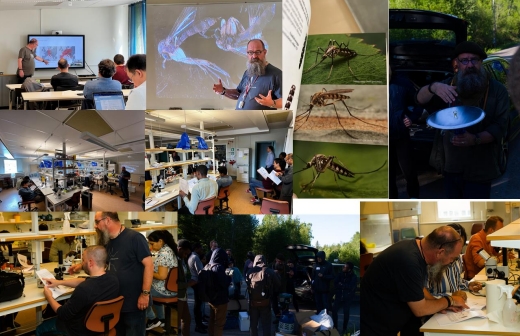
Collection of photos from the course including: lecture on “Swedish mosquito vectors” given by Anders Lindström, the Swedish National Veterinary Institute (SVA); laboratory practical on the morphological identification of mosquitoes; and field demonstration. Photo: Kristoffer Ahlm.
Joint Programming Initiative on Antimicrobial Resistance (JPIAMR) in partnership with the Medical Research Council (MRC UKRI) are hosting a workshop on antibiotic resistance.
The deadline for submitting an abstract has passed but you can still register to attend the online workshop on 9 June 2022, 13.00-17.20 (CEST).
Do you want to contribute to top quality medical research?
NDPIA Director of Studies Dr. Edmund Loh and his group are looking for a postdoctoral research fellow to work on a project on RNA-mediated pili regulation in the meningococcus.
The Edmund Loh Lab is focusing on RNA-mediated molecular mechanisms that are involved in bacterial pathogenesis. The pathogen of research is Neisseria meningitidis (meningococcus) and we utilise a wide variety of genetic, cell biological and biochemical methods and techniques. The research in Dr. Loh’s group focuses on the regulation of sRNAs and their gene expression patterns during various biological stress conditions.
It is a pleasure for the Organizing Committee to announce that the 19th symposium will be held at Smögens Hafvsbad, Smögen, Thursday August 25 to Saturday August 27, 2022 with the possibility to participate online as well.
The scientific as well as the social agenda will be very much like previous Smögen meetings. This year we will have the pleasure to listen to, and discuss with Dr Michael Worobey, Dr Timo Vesikari, and Dr. Karen Mossman on the subjects of virus origins, vaccines, and viruses evading the immune defence.
Kristina Nyström, Niklas Arnberg och Johan Nordgren